
← Back to Research

๐Ÿ“˜ Research summary · Poster

Acoustic entropy as a control state for WAAM restarts

Entropy-Aware Model Predictive Control for Transient Quality Mitigation in Wire-Arc Additive Manufacturing

Md Shafikul Islam, Mahathir Mohammad Bappy, Safiur Rahman Tushar

LSU Control Systems Symposium, 2026. doi:10.31390/lsucontrol.26.12 · Simulation and surrogate-model study

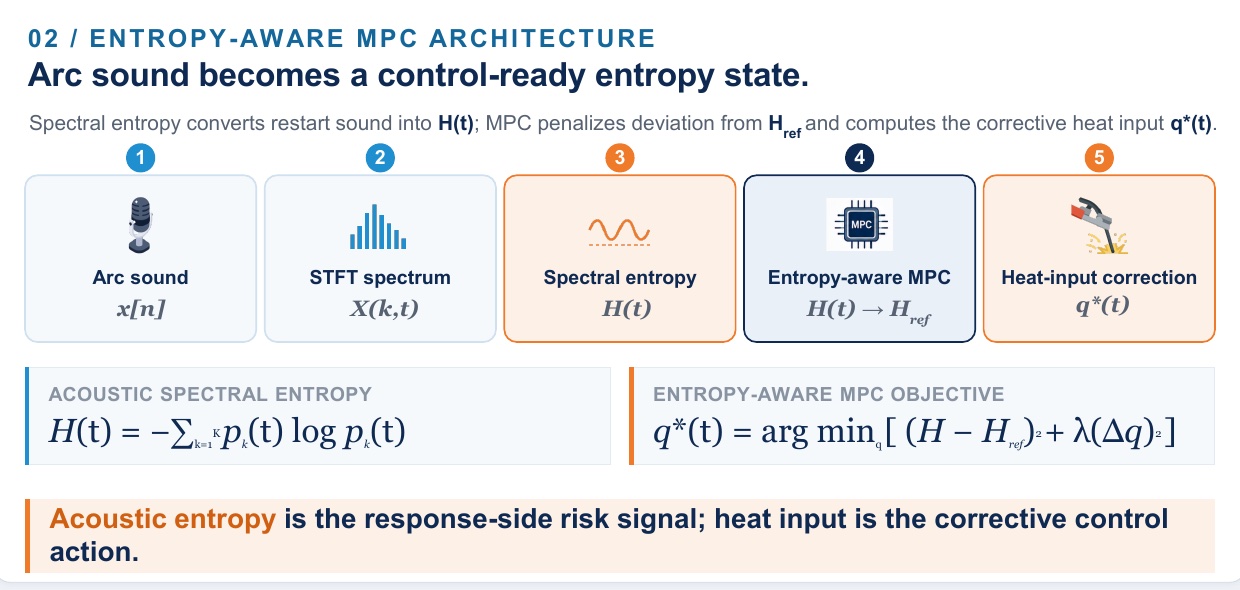
Entropy-aware MPC architecture: arc sound, STFT spectrum, spectral entropy H(t), MPC, and heat-input correction q*(t).
โšก TL;DR

Pause-induced cooling creates a restart transient in WAAM that electrical signals often fail to reveal. We show that the spectral entropy of the arc sound collapses during this transient and use it as the state of a model predictive controller. In a simulation and surrogate-model study, the entropy-aware controller shortens restart recovery by 47% and reduces the quality-deviation AUC by 35% relative to a thermal-only baseline.

Concept animation: entropy recovery and heat correction
Arc-sound entropy after a cold restart stable band time after restart entropy H(t) thermal-only MPC entropy-aware MPC Heat-input correction q(t) front-loaded pulse Shapes are illustrative. Measured curves are on the poster.

๐ŸŽฏ Problem

When deposition pauses, the part cools and acts as a heat sink. At restart, current and voltage can remain within their nominal ranges while bead morphology and quality drift. Controllers that rely on electrical or thermal states alone may therefore miss a transient that later appears as a defect.

๐Ÿ’ก Approach

Treat the arc's acoustic signature as a response-side quality signal. Its spectral entropy H(t) provides a compact, control-ready state. An entropy-aware MPC tracks a reference entropy Href while penalizing abrupt changes in heat input, which yields a short, front-loaded correction.

๐Ÿงฉ Method

Method overview

  1. 1

    Acoustic sensing

    A microphone records the arc signal x[n] throughout deposition and restart.

  2. 2

    Time-frequency analysis

    A short-time Fourier transform produces the spectrum X(k, t).

  3. 3

    Spectral entropy

    H(t) = -Σ pk(t) log pk(t) summarizes spectral spread; it drops sharply after a cold restart.

  4. 4

    Surrogate dynamics and MPC

    Learned models (DMDc, SINDy) predict the response; MPC solves q*(t) = argmin [(H - Href)2 + λ(Δq)2].

  5. 5

    Heat-input correction

    The optimal input applies a front-loaded heat pulse and relaxes as entropy re-enters the stable band.

๐Ÿ“Š Results

Key findings

All results come from simulation with learned surrogate models, not physical experiments.

47%
Faster restart recovery
35%
Lower quality-deviation AUC
2.8s
Settling time, DMDc + entropy-aware MPC (6.7 s thermal-only)
0.054
Risk AUC, DMDc + entropy-aware MPC (0.222 thermal-only)
  • Adding the entropy objective reduced settling time and entropy-risk AUC for both DMDc and SINDy surrogate models; DMDc with entropy-aware MPC performed best.
  • Across hold-out runs, larger entropy drops were associated with a higher flaw-density proxy, supporting arc sound as an in-situ quality-risk signal.
  • Recovery remained stable under plus or minus 5% drift in the SINDy model parameters.

๐Ÿญ Significance

Acoustic sensing is inexpensive and non-contact, and it responds to process quality rather than to the commanded electrical inputs. Using it as a control state is a step toward robotic WAAM cells that detect and correct transients during the build instead of relying on post-build inspection.

๐Ÿ“„ Citation and links

Md Shafikul Islam, Mahathir Mohammad Bappy, Safiur Rahman Tushar. "Entropy-Aware Model Predictive Control for Transient Quality Mitigation in Wire-Arc Additive Manufacturing." LSU Control Systems Symposium, 2026. doi:10.31390/lsucontrol.26.12.