
← Back to Research

๐Ÿ“˜ Research summary · Preprint

Privacy-preserving graph learning for porosity detection

Feature-Aware Anisotropic Local Differential Privacy for Utility-Preserving Graph Representation Learning in Metal Additive Manufacturing

Islam, M. S., Bappy, M. M., Tushar, S. R., Arifuzzaman, M.

Major revision at ASME Journal of Computing and Information Science in Engineering (JCISE). arXiv:2604.05077, 2026 · Under major revision

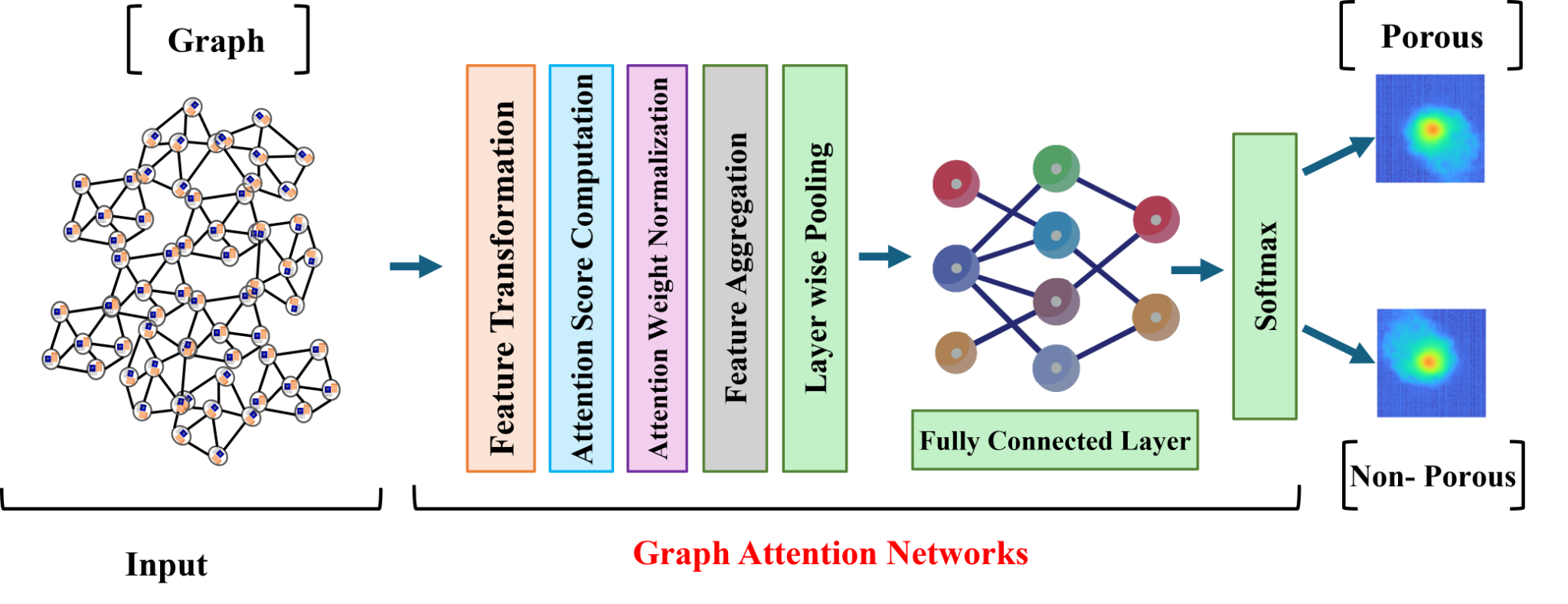
Graph attention network that classifies each node of the layer-wise melt-pool graph as porous or non-porous.
โšก TL;DR

In-process melt-pool data improve porosity detection, but sharing it across organizations exposes process know-how. We apply local differential privacy at the embedding level and allocate noise anisotropically, guided by Grad-CAM channel importance, before building a layer-wise graph for a GATv2 classifier. The approach retains much of the non-private utility while providing an explicit per-sample privacy guarantee.

Concept animation: a build layer as a graph
One build layer as a graph Legend melt-pool image (node) flagged as porous k-nearest-neighbor edge privacy noise (jitter) Illustration of the idea, not real data.

๐ŸŽฏ Problem

Porosity reduces fatigue life and structural integrity in laser-based additive manufacturing. Data-driven detectors benefit from pooled in-process data, yet thermal and optical frames can reveal proprietary process information. In addition, many models classify melt-pool observations independently and ignore their spatial context within a layer.

๐Ÿ’ก Approach

Privatize each observation locally, before it is shared, and make the noise feature-aware and anisotropic: the privacy budget is concentrated on informative directions instead of being spread uniformly. A graph attention network then exploits neighborhood structure among observations in the same layer.

๐Ÿงฉ Method

Method overview

  1. 1

    Embedding

    A CNN encodes each melt-pool frame into a feature vector.

  2. 2

    Channel importance

    Grad-CAM estimates how strongly each embedding channel contributes to porosity prediction.

  3. 3

    Anisotropic local DP

    Gaussian noise is allocated per coordinate according to channel importance, giving a per-sample privacy guarantee.

  4. 4

    Graph construction

    Observations within a build layer are linked by k-nearest neighbors in a hybrid space of coordinates and features.

  5. 5

    Node classification

    A node-level GATv2 classifies each observation as porous or sound.

๐Ÿ“Š Results

Key findings

Compared against a non-private baseline and a uniform local DP baseline.

  • Feature-aware local DP retains much of the non-private model's utility while offering explicit per-sample privacy.
  • Concentrating the privacy budget on informative directions outperforms uniform noise allocation at comparable privacy.
  • The graph formulation captures layer-wise spatial context that independent image classifiers do not use.

๐Ÿญ Significance

The method supports privacy-preserving quality assurance in multi-stakeholder settings, such as AM-as-a-service platforms, where participants benefit from shared models but cannot share raw process data.

๐Ÿ“„ Citation and links

Islam, M. S., Bappy, M. M., Tushar, S. R., Arifuzzaman, M.. "Feature-Aware Anisotropic Local Differential Privacy for Utility-Preserving Graph Representation Learning in Metal Additive Manufacturing." Major revision at ASME Journal of Computing and Information Science in Engineering (JCISE). arXiv:2604.05077, 2026.